
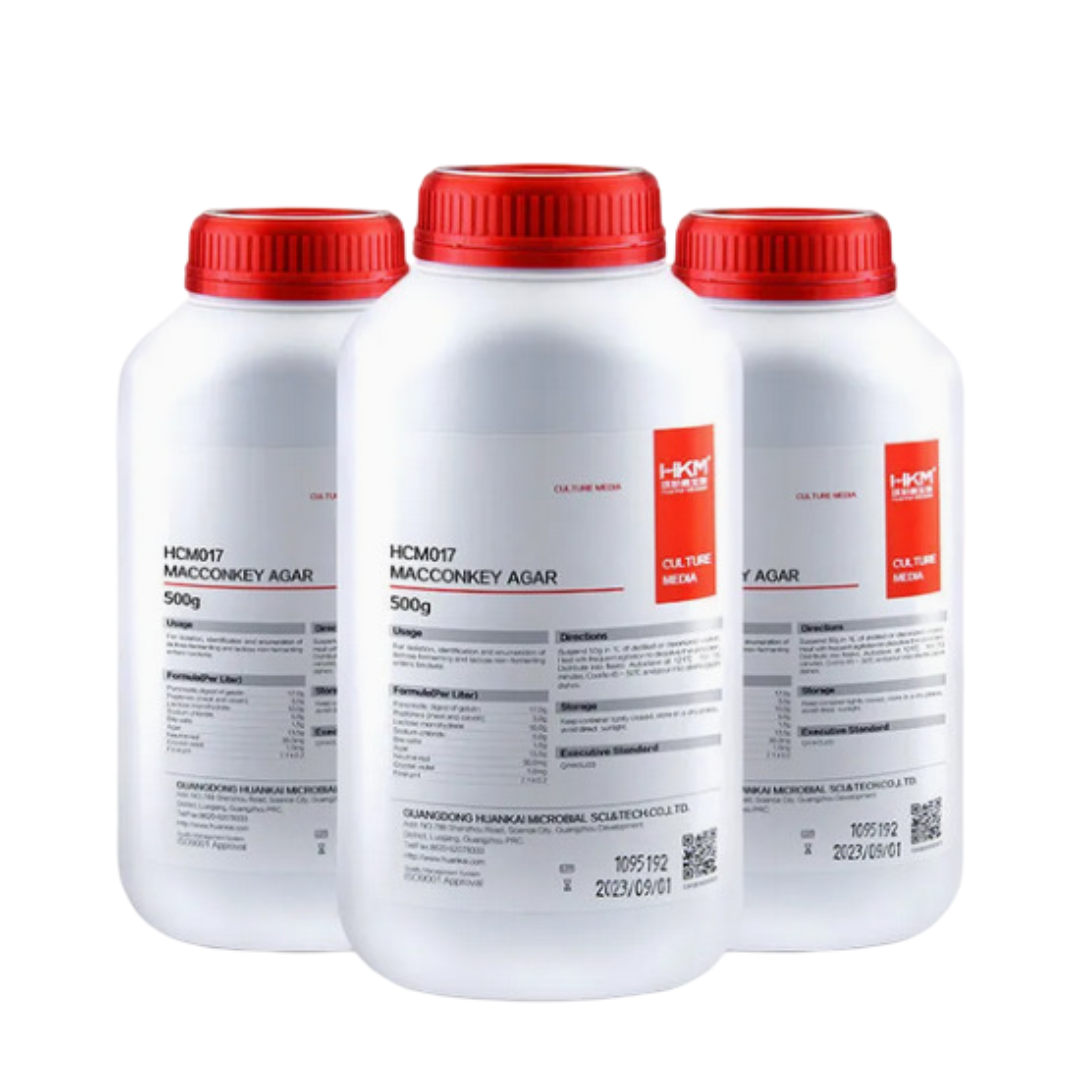
Function and Principle
- Selective Action: The agar contains bile salts and crystal violet dye, which inhibit the growth of most gram-positive bacteria. This allows for the selective isolation of gram-negative organisms.
- Differential Action: The medium contains lactose (a carbohydrate source) and the pH indicator neutral red. The differentiation works as follows:
- Lactose Fermenters (Lac+): Bacteria that ferment lactose produce acidic byproducts, such as lactic acid. This lowers the pH of the medium below 6.8, causing the neutral red indicator to turn bright pink or red. Strong fermenters like Escherichia coli may produce a bright pink color and a hazy zone of precipitated bile salts around their colonies. Other examples include Klebsiella and Enterobacter spp..
- Non-Lactose Fermenters (Lac-): Bacteria that do not ferment lactose use other ingredients like peptone, which produces alkaline byproducts (ammonia). This does not change the pH of the medium significantly (it remains above 6.8), so the colonies appear colorless or transparent and the surrounding agar remains unchanged. Examples include Salmonella, Shigella, and Proteus spp..
Clinical Significance
This agar is an important diagnostic tool in clinical and public health laboratories for:
- Identifying potential pathogens: It helps to quickly distinguish common gut pathogens (which are often non-lactose fermenters) from normal commensal flora (which are often lactose fermenters).
- Testing samples: It is widely used for the microbiological examination of clinical samples like stool and urine, as well as water and dairy products, to detect contamination by enteric pathogens.
Related products
Culture Media

Culture Media

Culture Media