
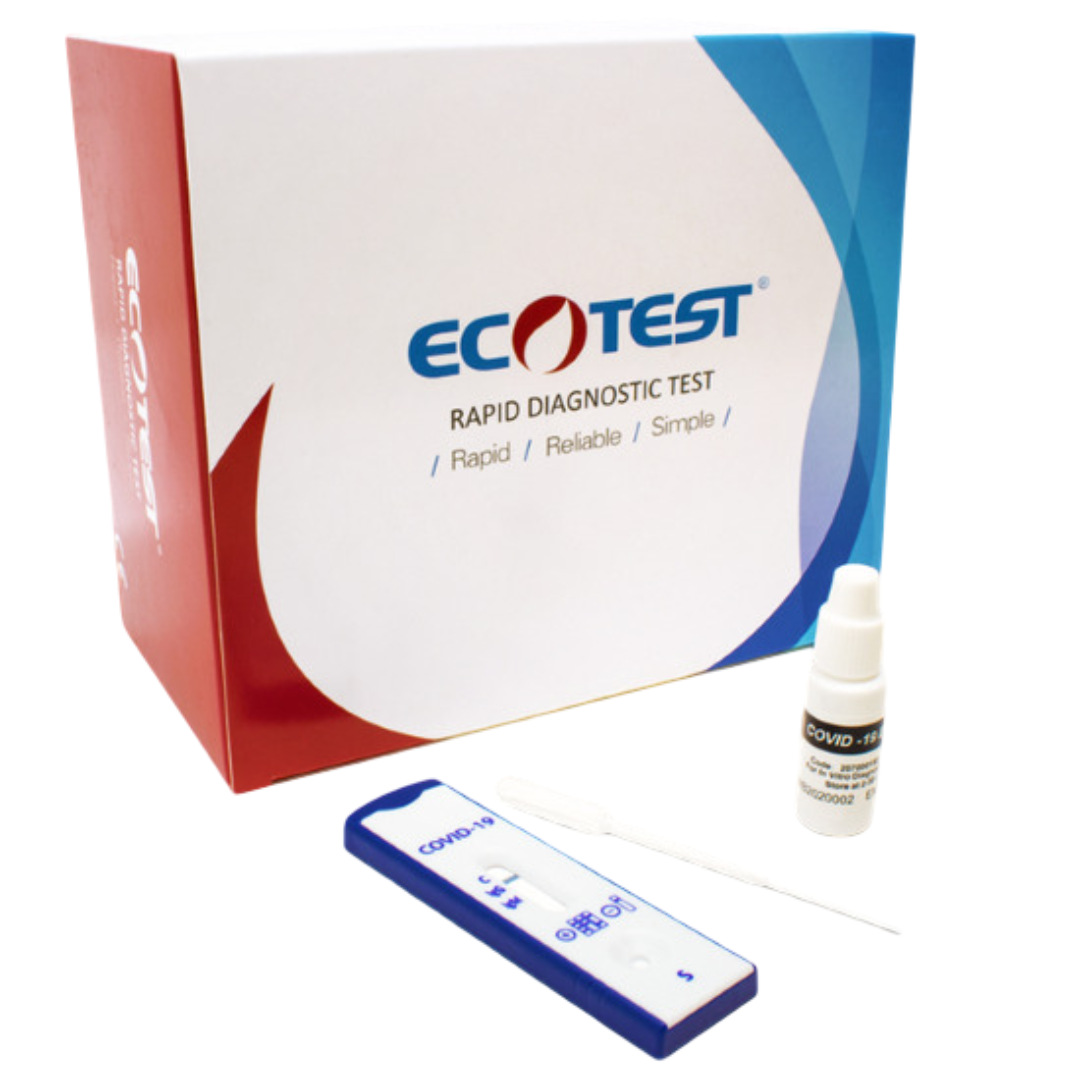
Ecotest COVID-19 Test Kit
The Ecotest COVID-19 Test Kit is a rapid antigen test (RAT) used for the qualitative detection of SARS-CoV-2 viral nucleoprotein antigens, available in both nasal swab and less-invasive saliva pen formats. These single-use tests are designed for self-testing at home or for point-of-care use by healthcare professionals.
Key Features and Benefits
- Rapid Results: Provides results in 15 minutes, allowing for quick screening and decision-making.
- Ease of Use: The saliva pen format is particularly known for being non-invasive and easy to use, especially for individuals who find nasal swabs uncomfortable (e.g., children or those with sensitive nasal passages).
- High Accuracy (When Used Correctly): The tests are clinically validated, with the nasal swab version showing a high relative sensitivity (98.1%) and specificity (99.8%) in clinical evaluations. The saliva test has an acceptable sensitivity (around 88.9%) and high specificity.
- Variant Detection: The test kits are designed to detect known SARS-CoV-2 variants such as Alpha, Beta, Gamma, Kappa, and Delta.
- Internal Control: Each test device features an internal control line (“C” region) that confirms the test has run correctly with a sufficient sample volume.
How to Use
The exact procedure depends on whether you are using the nasal swab or saliva pen version, but both are straightforward.
General Steps:
- Preparation: Wash hands thoroughly. Ensure all components are at room temperature.
- Sample Collection:
- Nasal Swab: Insert the swab gently into the nostril (about 1-2 cm deep) and rotate it against the nasal wall for about 15 seconds, then repeat in the other nostril.
- Saliva Pen: Deeply cough a few times, then place the collector tip under or to the side of the tongue for two minutes to collect saliva. Do not eat, drink, smoke, brush teeth, or chew gum for 30 minutes before this test.
- Processing: Place the collector into the extraction buffer tube, rotate it, and then add a few drops of the solution to the sample well of the test device.
- Reading Results: Read the results at 15 minutes. Do not interpret the result after 30 minutes, as this can lead to inaccuracies.
- Positive: Two lines appear (Control “C” and Test “T”). Any shade of the “T” line should be considered positive.
- Negative: Only one line appears at the control region “C”.
- Invalid: The control line fails to appear. The test should be discarded and repeated with a new kit.
Important Considerations
- A negative result does not completely rule out SARS-CoV-2 infection, especially if testing occurs outside the first seven days of symptom onset.
- If you have symptoms or a positive result, you must follow the advice from your local public health authority for guidance on confirmation testing (e.g., PCR test) and isolation measures.
Related products
Rapid Diagnostics Kits
Rapid Diagnostics Kits
Rapid Diagnostics Kits
Rapid Diagnostics Kits
Rapid Diagnostics Kits